

NuBiS – Use of biomass along the rail infrastructure
Background
The rail network in Germany currently has a total length of approximately 38,500 km. The largest network operator is DB AG with around 33,500 km. In order to ensure traffic safety and facility responsibility for safe and reliable rail operations, the rail infrastructure requires vegetation management and appropriate vegetation maintenance. Due to the extensive network, large quantities of biomass accumulate along the railways and operating areas, which are cleared at fixed intervals. Vegetation maintenance is constantly caught between the conflicting priorities of safety, route availability, economic efficiency, and environmental compatibility.
Project aim
The aim of the research project is to determine the biomass potential along rail transport areas and to carry out a quantitative and qualitative evaluation with regard to the potential use or further utilization of the green waste produced. In addition, a cost-benefit analysis will be carried out with regard to possible usage paths. Based on this, recommendations for action will be presented in the overall context of climate protection for GHG reduction.
Project schedule
The analysis and evaluation of the subject area and the concepts to be developed in this context will be carried out in several work packages.
Workpackage 1: Identification and investigation of biomass
First, the study area will be classified into meaningful categories (clusters) with the aim of identifying representative locations for measuring the existing biomass potential. To map the biomass quantities at the selected locations, we use a drone with a LiDAR scanner to capture the shape and surface characteristics of the vegetation in high resolution and display it in a 3D model. In a next step, current satellite data will be used to estimate the biomass accumulated along the rail network throughout Germany.
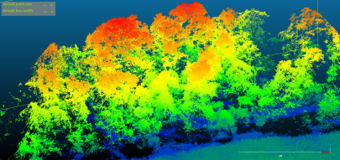
Example: Drone image of a forest area with
LiDAR-Scanner (Image Source: U-ROB GmbH)
Workpackage 2: Strategy for removal and utilization concepts
The aim of WP 2 is to develop utilization methods for the material and energetic use of the identified biomass potential, including the techniques used to collect and remove the green waste. The technical, legal, and ecological restrictions necessary for the subsequent evaluation and prioritization of the utilization concepts are to be compiled.
Workpackage 3: Evaluation and recommendations for action
Finally, the previous project results will be compiled and classified. Based on this, a detailed catalog of strategies and measures will be created that enables economically and ecologically sensible use of the existing biomass potential while taking regulatory and technical requirements into account.
Client:
German Center for Rail Traffic Research at the Federal Railway Authority
Subcontractors:
Rottenburg University of Applied Forest Sciences
TransMIT – Society for Technology Transfer mbH, Project Area Public Transport and Traffic Management
Laufzeit:
09/2025 bis 02/2027
Kontakt:
Patrick Marx
Arbeitsfeld:
Stoffströme